
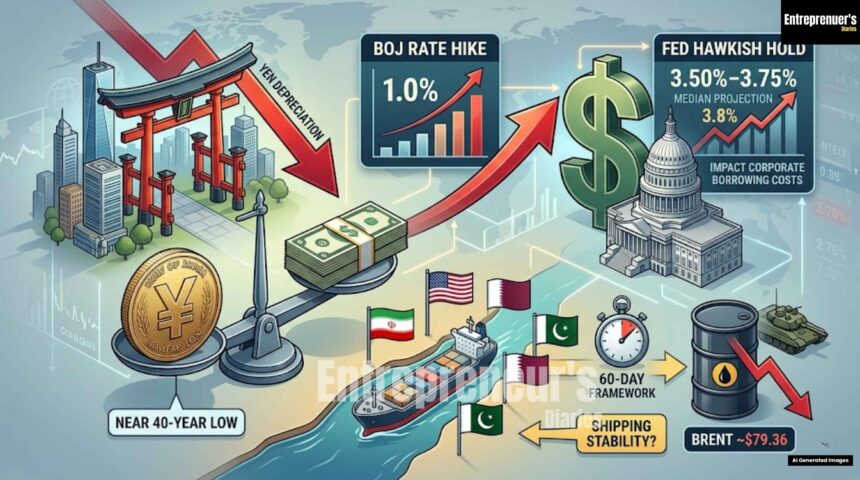
TOKYO/WASHINGTON, Monday, June 22, 2026: For business leaders tracking borrowing costs, import bills, and currency exposure this week, three things just happened at once. Japan’s yen intervention has now been officially confirmed as the largest in its history, the US dollar held steady after the first round of direct US Iran diplomacy concluded with a tentative 60 day framework, according to a report published by Econo Times, and the Japanese yen stayed pinned near its weakest level in nearly four decades.
None of this is abstract for companies with operations, suppliers, or revenue tied to Japan, the US, or the Middle East shipping lanes. This report breaks down exactly what the yen intervention, the dollar’s stability, and the yen’s slide mean for businesses managing currency exposure, and which figures come from official central bank and finance ministry sources versus market commentary.
The Headline Numbers Businesses Are Reacting To
The dollar remained largely stable on Monday after the first round of diplomatic talks between Washington and Tehran concluded with signs of progress, EconoTimes reported. For companies pricing contracts in dollars, that stability is itself useful information it means no sudden repricing pressure from this particular headline, at least for now.
US Treasury yields climbed on the session, with the 2 year yield reaching 4.23%, according to the same EconoTimes report. Treasury yields are a direct input into corporate borrowing costs, so this move matters well beyond bond traders it’s a signal that short term business loans and credit lines tied to US rates are not getting cheaper anytime soon.
Traders are currently pricing in roughly 43 basis points of further Fed tightening, with a quarter point increase fully expected by September, EconoTimes reported. That repricing traces directly back to the Federal Reserve’s own June 17 policy meeting, covered in detail further below.
Inside the US Iran Framework: What It Means for Supply Chains
According to a joint statement issued by mediators Qatar and Pakistan, cited by EconoTimes, Washington and Tehran agreed on a framework aimed at reaching a final agreement within 60 days. For any business with shipping routes, energy contracts, or suppliers touching the Middle East, that 60 day window is now a real planning horizon.
The framework reportedly includes a mechanism designed to wind down hostilities in Lebanon, EconoTimes reported, alongside the establishment of communication channels intended to secure the safe movement of commercial vessels through the Strait of Hormuz one of the world’s most important shipping corridors for the goods and energy that move global supply chains.

The relief is not unqualified, and businesses should treat it that way. EconoTimes noted that market sentiment remained fragile after President Donald Trump warned that military action could resume if negotiations fail, even as Iran simultaneously confirmed it had gone ahead with closing the strait.
For procurement and logistics teams, that tension is the practical takeaway: there is a genuine diplomatic opening, but it sits directly next to a live disruption risk that has not been retired.
Yen Intervention Risk Builds as the Slide Hits Exporters and Importers
The Japanese yen weakened to 161.55 per dollar on Monday, hovering close to multi decade lows, EconoTimes reported exactly the kind of move that has already triggered Japan’s largest confirmed yen intervention on record. For Japanese exporters, a weak yen is generally a tailwind, making their goods cheaper for foreign buyers. For Japanese importers, and for foreign companies buying from Japan in dollars, it cuts the other way on input costs and margins.
This is not a one day move, and it’s the reason yen intervention keeps coming back onto the table. An earlier EconoTimes report, published June 19, 2026, described the yen as trading close to its weakest level in nearly four decades, even after the Bank of Japan had just raised interest rates to their highest level since 1995.
That report flagged two structural pressures businesses should keep on their radar, both of which keep the case for further yen intervention alive. The first is fiscal: investor unease over Prime Minister Sanae Takaichi’s spending plans has raised doubts about Japan’s fiscal discipline, EconoTimes reported. The second is an inflation timing gap Japan’s core inflation stayed below the BOJ’s 2% target for a fourth straight month in May, partly cushioned by government fuel subsidies that won’t last indefinitely.

Capital Economics, cited in that report, expects inflation to accelerate toward 3.5% by early 2027 as higher energy costs gradually filter into utility bills and consumer prices. Businesses budgeting input costs in yen should treat that forecast as a planning input, not a footnote and should assume yen intervention remains a live possibility for as long as the slide continues.
Bank of Japan’s Rate Hike: What It Means for Borrowing Costs
The Bank of Japan’s own policy statement, published on its official website on June 16, 2026, confirms the central bank raised its key short term rate by 25 basis points to 1.0%. For any business with yen denominated loans, that is a direct, confirmed increase in the cost of capital in Japan.
The vote was 7-1, with board member Asada Toichiro dissenting on the grounds that downside risks to production and employment outweighed upside risks to prices, according to the BOJ’s official release. Governor Kazuo Ueda was recorded as absent from that vote, a detail later confirmed independently by Trading Economics, which described it as the central bank’s first regular policy meeting without the governor in attendance.

In its policy statement, the Bank said it would continue to raise the policy interest rate and adjust the degree of monetary accommodation in response to economic, price, and financial developments, while closely monitoring the impact of the Middle East situation on Japan’s economy. That language, taken directly from the BOJ’s official release, tells business borrowers not to assume this is the last hike of the cycle.
BOJ Deputy Governor Ryozo Himino reinforced that message days later. Speaking to parliament, Himino said: “There is a risk underlying inflation may deviate upward from our target,” according to Trading Economics’ reporting on his testimony. He added that wholesale inflation has been accelerating as firms pass on higher costs stemming from the Middle East conflict a direct line from oil prices to the prices Japanese businesses charge each other.
The 1.0% rate is the highest level for Japanese borrowing costs since September 1995, per Trading Economics. It follows the BOJ’s exit from negative interest rates in March 2024 and a steady, staged normalization path under Ueda since then a multi year shift that has been gradually raising the cost of yen financing for businesses throughout that period.
Tokyo’s Record Intervention: A Warning Sign for Currency Hedging
While the BOJ was raising rates, Japan’s Ministry of Finance was separately fighting the yen’s slide with direct market intervention and the ministry has now put an official number on it. According to data the ministry disclosed and reported by The Japan Times, total intervention for the period from April 28 to May 27, 2026 came to ¥11.73 trillion, or $73.6 billion.
That is described by The Japan Times as a record monthly total and the government’s first officially confirmed market intervention since 2024. For corporate treasury teams that hedge yen exposure, this is the clearest possible signal that currency volatility risk has not gone away just because the headline rate looks “steady.”
The total was larger than markets had expected. The Japan Times reported that calculations based on central bank flow data had pointed to spending of as much as ¥10.08 trillion across two known rounds of action, meaning the official figure implies additional, previously unconfirmed activity exactly the kind of surprise that makes unhedged currency exposure risky for businesses right now.
Rinto Maruyama, senior FX and rates strategist at SMBC Nikko Securities, offered one explanation. “This raises the possibility that stealth intervention was conducted in the ¥158.50 ¥159.50 range,” Maruyama said, according to The Japan Times, adding that this would likely strengthen arguments about the limits of unilateral intervention.
There is a hard ceiling on how often Tokyo can repeat this, and it matters for how long businesses should expect this kind of support to continue. An unnamed Finance Ministry official told reporters, per The Japan Times’ earlier coverage, that International Monetary Fund classification rules treat three episodes of intervention within six months with three consecutive days counted as a single episode as the threshold for remaining classified as a freely floating exchange rate regime.
Japan’s finance minister, Satsuki Katayama, has said authorities can take bold action against speculative currency moves consistent with an existing US Japan understanding, The Japan Times reported. Whether that translates into a third round of intervention this year remains, as of this report, undecided and businesses planning yen budgets into Q4 should build that uncertainty into their planning rather than assume continued official support.
The Fed’s Hawkish Hold: What It Means for US Business Borrowing
On the US side of the ledger, the Federal Reserve’s own June 17, 2026 press release, published on the Federal Reserve Board’s official website, confirms the Federal Open Market Committee voted 12-0 to maintain the federal funds rate target range at 3.50% to 3.75%. For businesses with floating rate US debt, that means no immediate change in borrowing costs but the detail underneath the decision suggests that calm may not last.
The Fed’s official statement was measured in tone. “Economic activity is expanding at a solid pace,” the Committee said, adding that this came “despite elevated uncertainty that owes, in part, to the conflict in the Middle East.” The statement also noted that inflation remains elevated relative to the Committee’s 2% goal, “in part reflecting supply shocks that have driven price increases in certain sectors, including energy” a direct acknowledgment that the same Middle East conflict pushing up business energy costs is also shaping US monetary policy.
The detail markets actually repriced around sat one layer down, in the Fed’s quarterly Summary of Economic Projections. According to reporting from StockTitan based on the Fed’s own released projections, the median policymaker estimate for the federal funds rate at the end of 2026 rose to 3.8%, up from 3.4% in the March projections a shift from implying a cut this year to implying a hike, with direct implications for any business planning to refinance debt later this year.
The projections grid was split but leaning hawkish: of 18 officials who submitted projections, eight placed their dot at the current 3.625% midpoint, one was below it, and nine were above it, StockTitan reported, with the full range running from 3.4% to 4.1%. Separately, Fox Business reported that 17 of 18 officials judged inflation risks to be tilted to the upside.
This was also the first meeting chaired by Kevin Warsh, who took over as Fed Chair this year, and he used it to change how the Fed communicates rather than just what it decided. Asked about the shorter post meeting statement, Warsh said: “It’s a bit shorter, a bit simpler and it dispenses with some older language,” according to CNBC’s reporting on his press conference.
For business leaders trying to forecast rate direction, the reaction from Wall Street economists is a useful gauge. Seema Shah, chief global strategist at Principal Asset Management, was quoted by Fox Business describing the substance of the meeting as hawkish even though Warsh had changed the Fed’s presentation style. Ellen Zentner of Morgan Stanley Wealth Management told Fox Business she still expects the Fed’s next move to ultimately be a cut, but said it will take time for inflation to ease enough to give the Committee room to act.
Oil, Shipping, and the Strait of Hormuz: The Real Cost Driver
Energy markets are the direct link between the Iran diplomacy and the cost lines on most business income statements this week. Brent crude futures fell more than 1% to around $79.36 a barrel on Monday, EconoTimes reported, as the de escalation headlines came through a small but real relief for any business whose freight, fuel, or input costs track crude.
Analysts cited by EconoTimes cautioned that energy markets remain fundamentally tight, and that currencies and gold are both likely to stay highly sensitive to any further developments out of the Middle East. That caution is the reason Monday’s calm in oil prices should be read by business planners as a pause, not a new normal.
The Strait of Hormuz sits at the center of why this matters disproportionately for shipping costs and input pricing. It is the corridor the new US Iran framework specifically addresses through its proposed communication channels for commercial shipping, according to EconoTimes’ reporting on the joint statement even as Iran has, per the same report, gone ahead with closing it. Any business with goods moving through that corridor, or with energy contracts priced off benchmarks that flow through it, has a direct stake in how this resolves over the next 60 days.
Other Currencies Businesses Are Watching
Sterling was the session’s other notable mover, and for entirely separate reasons relevant to companies with UK exposure. GBP/USD fell 0.21% to $1.3210 as traders weighed fresh UK political uncertainty, EconoTimes reported, after Labour rival Andy Burnham scored a decisive parliamentary election win that raised questions about Prime Minister Keir Starmer’s position.
Analysts at OCBC, cited in the same EconoTimes report, kept a neutral outlook on the pound, suggesting the initial weakness may not persist if UK fiscal policy stays unchanged. For businesses invoicing in sterling, that is a meaningfully different risk driver than the one moving the dollar and yen, and worth tracking separately rather than lumping it into the broader Iran driven narrative.
Elsewhere on the board, per EconoTimes’ Monday report: the euro recovered some lost ground to trade near $1.1465; the Australian dollar held around $0.7011; and the New Zealand dollar traded near $0.5730. None of the three showed the kind of dramatic move seen in the yen or the pound, which is itself useful information for treasury teams deciding where to focus hedging attention this week.
What Remains Unverified or Inconsistent
In the interest of accuracy, a few details in this week’s reporting could not be fully reconciled and are flagged here rather than stated as settled fact.
The exact relationship between the new 60 day US Iran framework and the Strait of Hormuz closure is not entirely clear from the available reporting. EconoTimes’ report describes a mechanism for “safe movement of commercial vessels” through the strait as part of the same announcement that confirms Iran has closed it the reporting does not specify whether the closure has been lifted, partially eased, or remains fully in place pending the 60 day process. Businesses with shipments in transit should treat this as an open question rather than assume normal flow has resumed.
The April May intervention total cited in EconoTimes’ June 19 report (approximately ¥11.7 trillion, attributed to IG analyst Tony Sycamore’s estimate) is consistent with, but not identical in framing to, the Ministry of Finance’s own officially disclosed figure of ¥11.73 trillion ($73.6 billion) reported by The Japan Times. The two numbers align closely; this report uses the Ministry of Finance’s own confirmed figure as the primary source where the two are cited together.
Finally, two outlets gave slightly different breakdowns of the Fed’s June dot plot: StockTitan described 9 of 18 officials placing their 2026 dot above the current midpoint, while Fox Business separately reported “nine of the 18 voting members” projecting a hike with “six projecting two 25 basis point hikes.” The two figures are broadly consistent on the headline hawkish tilt; this report cites both outlets by name rather than presenting a single unverified composite number.
What This Means for Entrepreneurs and Business Leaders
Strip away the daily percentage moves, and three threads matter more than any single session’s close for businesses planning the next quarter.
The first is that the world’s two most important central banks for global trade are now pulling in different directions for related but distinct reasons, and that divergence has a direct line to your cost of capital. The Fed held rates but quietly turned more hawkish under a new chair who is explicitly changing how the Fed communicates. The BOJ, by contrast, is actively hiking into a below target inflation print, betting that energy driven price pressure is coming regardless of what today’s data shows.
For any business with dollar denominated debt or yen denominated revenue, that is the engine behind why USD/JPY keeps grinding toward levels that have already triggered Japan’s largest confirmed currency intervention on record and why “wait and see” is a riskier hedging strategy than it looked a month ago.
The second is that Tokyo’s options to keep supporting the yen are visibly running low, in a way that is officially documented rather than speculative. The Ministry of Finance’s own disclosed $73.6 billion in spending over a single month, combined with the IMF’s rule treating no more than three intervention episodes per six months as consistent with a free floating currency, means Japan has a countable, finite number of moves left before this year end. Businesses budgeting on the assumption that Tokyo will always step in to defend ¥160 should treat that assumption as time limited.
The third is the one easiest to miss in a week that opened on a relatively calm headline number: the dollar’s stability on Monday reflects cautious optimism on Iran, not resolution. President Trump’s own warning that military action could resume if talks fail is doing real work to keep risk premiums elevated, and the Strait of Hormuz the single corridor this entire shipping and energy cost story runs through was, per Monday’s own reporting, still described as closed even as the framework to reopen it was being announced.
The businesses and entrepreneurs who navigate this best will not be the ones reacting to a single day’s basis point move in the 2 year Treasury yield. They will be the ones tracking three specific, checkable items over the coming weeks: whether the 60 day US Iran framework holds through its first real test, whether Japan’s Ministry of Finance discloses a third round of intervention before its IMF defined window closes, and whether the Fed’s median dot now implying a hike rather than a cut actually converts into a rate move at its next scheduled meeting.
Frequently Asked Questions
1. How does the weak yen affect businesses that import from or export to Japan?
A weaker yen, currently near 161.55 per dollar according to EconoTimes, generally makes Japanese exports cheaper for foreign buyers while raising the dollar cost of goods and services Japanese companies buy from abroad. Businesses on either side of that trade are operating with a currency that the Bank of Japan itself has been actively trying to support through both rate hikes and direct market intervention.
2. What does the Bank of Japan’s rate hike mean for businesses borrowing in yen?
The BOJ raised its policy rate by 25 basis points to 1.0% on June 16, 2026, according to its own official statement the highest level since September 1995, per Trading Economics. That is a direct increase in the benchmark cost of yen denominated borrowing, and the BOJ’s own statement signals it is prepared to keep raising rates further depending on how inflation and the Middle East situation evolve.
3. Has Japan officially confirmed intervening in currency markets in 2026?
Yes. Japan’s Ministry of Finance officially disclosed total intervention of ¥11.73 trillion ($73.6 billion) for the period from April 28 to May 27, 2026, according to The Japan Times’ reporting on the ministry’s own released data described as a record monthly total and the government’s first officially confirmed intervention since 2024.
4. Is there a limit on how often Japan can intervene to support the yen?
Yes. A Finance Ministry official told reporters, per The Japan Times, that IMF classification rules treat no more than three intervention episodes within a six month window as consistent with a freely floating currency regime, with three consecutive days of action counted as a single episode. That is a practical ceiling businesses should factor into how long official yen support can be expected to continue.
5. What did the Federal Reserve decide about US interest rates in June 2026, and what does it mean for business loans?
The Federal Open Market Committee voted 12-0 to hold the federal funds rate at a target range of 3.50% to 3.75% on June 17, 2026, according to the Federal Reserve’s own official press release. For now, that means no change in the benchmark rate behind most US business loans but the Committee’s updated projections raised the median year end 2026 rate estimate to 3.8% from 3.4% in March, per StockTitan’s reporting, signaling borrowing costs could rise later this year.
6. How does the Strait of Hormuz situation affect shipping and supply chain costs for businesses?
The Strait of Hormuz is one of the world’s most important shipping corridors, and the new US Iran framework specifically includes a mechanism aimed at securing safe passage for commercial vessels through it, according to EconoTimes’ reporting on the Qatar and Pakistan mediated joint statement. Because the same report notes Iran has closed the strait, businesses with shipments or energy contracts tied to that route face continued uncertainty until the 60 day process plays out.
7. Is the US Iran conflict officially resolved for business planning purposes?
No. The agreement described by EconoTimes is a 60 day framework aimed at reaching a final deal, not a concluded peace treaty, and the same report notes Iran confirmed it had closed the Strait of Hormuz even as the framework was announced. President Trump has also warned that military action could resume if negotiations fail, EconoTimes reported, meaning businesses should treat this as an active, ongoing situation rather than a closed chapter.
8. Who is Kevin Warsh, and why does his approach matter for business borrowing forecasts?
Kevin Warsh became Chairman of the Federal Reserve’s Board of Governors in 2026 and led his first FOMC meeting on June 17. According to CNBC’s reporting, Warsh shortened the Fed’s post meeting statement, removed language signaling a future rate cut bias, and declined to submit his own dot in the Fed’s projections grid a communication shift that makes it harder for businesses to read forward guidance the way they could under his predecessor.
9. How are the pound, euro, and Australian dollar performing, and does it matter for non Japan, non US businesses?
GBP/USD fell 0.21% to $1.3210 on UK political uncertainty tied to Labour rival Andy Burnham’s parliamentary election win, EconoTimes reported, with analysts at OCBC maintaining a neutral pound outlook. The euro traded near $1.1465, the Australian dollar held around $0.7011, and the New Zealand dollar traded near $0.5730, all according to the same EconoTimes report comparatively calm moves that businesses with exposure to those currencies can weigh separately from the more volatile yen and Iran driven dollar story.
10. What should business owners and finance teams watch next in this story?
Three checkable developments matter most: whether the 60 day US Iran framework survives its first real test without collapsing, whether Japan’s Ministry of Finance discloses any further currency intervention before its IMF defined six month window closes, and whether the Federal Reserve’s more hawkish dot plot translates into an actual rate hike at an upcoming meeting rather than remaining a projection.
Connect With Us On Social Media [ Facebook | Instagram | Twitter | LinkedIn ] To Get Real-Time Updates On The Market. Entrepreneurs’ Diaries Is Now Available On Telegram. Join Our Telegram Channel To Get Instant Updates.

Isabella is a global business journalist and former McKinsey analyst from Brazil. She brings sharp insights on economic shifts, policies, and founder journeys from around the world.

Tokyo-based CFA translating global markets into clear insights for modern entrepreneurs.