

SAN FRANCISCO, June 25, 2026 — The foundational business model of the generative artificial intelligence industry has just faced its most significant stress test. In a move that has sent shockwaves through tech and market economic business news US circuits, Anthropic has officially confirmed the Anthropic Claude extraction attack, a massive, prolonged campaign targeting its flagship Claude AI models.
While Anthropic’s official corporate disclosure stops short of naming the perpetrator, major financial journalism has identified the actor as Alibaba Group. This incident is not merely a cybersecurity breach. It is a stark illumination of the structural vulnerabilities in how frontier AI companies monetize their intellectual property.
For investors, founders, and market analysts, the implications are profound. The incident forces a recalibration of how we value AI moats, assess API driven revenue streams, and understand the evolving landscape of US China technological competition.
The Anthropic Claude Extraction Attack: What Anthropic Actually Said
To understand the market implications of the Anthropic Claude extraction attack, we must first establish the exact parameters of what was officially disclosed. According to the Anthropic Official Blog, in a specific publication detailing frontier AI security, the company revealed a sophisticated operation. Anthropic stated that its security systems detected and disrupted a prolonged extractive attack.
The company explicitly identified the threat actor as a “known Chinese AI company.” Anthropic did not name Alibaba in this official disclosure.

According to the Anthropic Official Blog, the attackers utilized a vast network of accounts. These accounts were used to systematically probe Anthropic’s Claude models. The goal was not standard usage. The stated objective of the attacker, as observed by Anthropic, was to extract the core reasoning capabilities and underlying knowledge embedded within the model.
Anthropic noted that this actor demonstrated a high level of technical sophistication. They actively worked to bypass Anthropic’s safety guardrails and usage policies designed to prevent mass data extraction. The official disclosure emphasizes that this was not an opportunistic script kiddie attack. It was a highly resourced, methodical campaign. Anthropic’s systems ultimately disrupted the operation before the attackers could fully achieve their objectives.
The Attribution: Connecting the Dots to Alibaba
Given Anthropic’s decision to withhold the name of the Chinese AI company in its official portal, market analysts and investors have relied on investigative financial journalism to complete the picture.
According to The New York Times, the Chinese AI company behind the Anthropic extraction attack was Alibaba. According to The New York Times, this information was confirmed by two anonymous individuals who possessed direct knowledge of the matter. The publication reported that Alibaba utilized the extracted data from Anthropic’s Claude to train its own competing large language model.
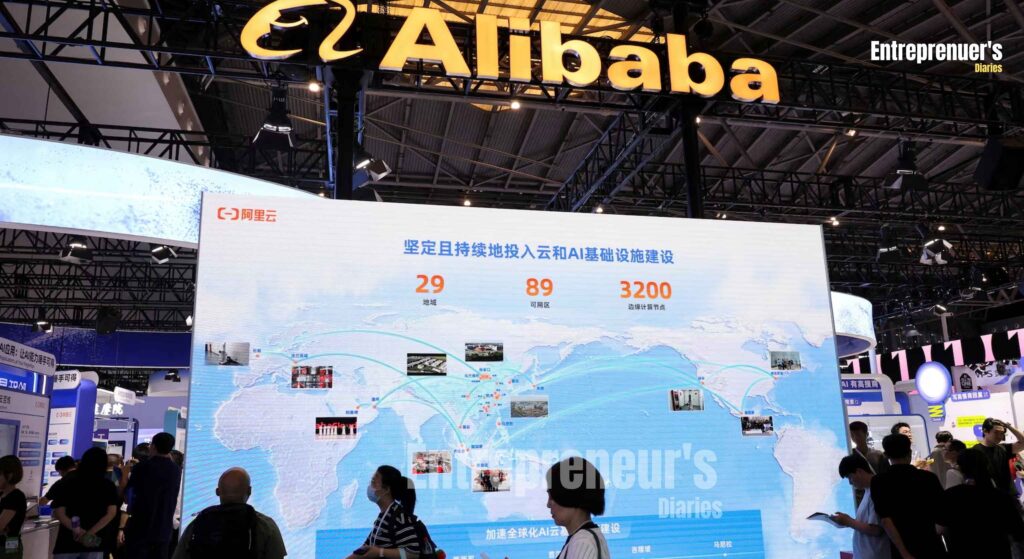
It is vital for market accuracy to state clearly: Alibaba has not issued an official public statement confirming or denying these specific allegations. The direct link between Anthropic’s official report and Alibaba exists solely through the reporting of The New York Times.
However, the market has treated this attribution as highly credible. Alibaba is a massive conglomerate with a deeply invested cloud and AI division. The economic motive aligns perfectly with Alibaba’s strategic need to compete in the global AI race.
The Mechanics of AI Extraction: A Market Economics Perspective
To grasp why this event is so critical for tech and market economic business news US, one must understand the mechanics of “model extraction” or “knowledge distillation.” Training a frontier AI model like Claude requires staggering amounts of capital. We are talking about hundreds of millions of dollars in compute power, tens of thousands of specialized GPUs, and months of engineering time.
The resulting model contains a compressed representation of vast human knowledge and complex reasoning pathways. This is the core intellectual property of an AI lab. Model extraction is an attempt to bypass the massive upfront capital expenditure of training. Instead of building a model from scratch, an attacker uses an existing, highly capable model to generate millions of high quality outputs.
These outputs are then used as the training data for a new, rival model. The rival model essentially learns to mimic the reasoning of the frontier model. According to the Anthropic Official Blog, this is exactly what the detected attackers were attempting. They were trying to use Claude’s outputs to distill a replica of Claude’s capabilities.
The economic disparity here is the crux of the issue. Extracting data via an API costs fractions of a cent per token. Training a frontier model costs hundreds of millions of dollars. If extraction is successful, the attacker achieves a comparable product at a fraction of the cost. This completely undermines the unit economics of the original AI developer.
The API Monetization Paradox
This incident exposes a fundamental paradox in the current AI business model. Frontier AI labs, including Anthropic, rely heavily on API access for revenue. Selling access to their models via APIs is the primary way they monetize their massive research and development investments.
To sell API access, you must allow external actors to send prompts to your model and receive outputs. However, every output generated is essentially a leak of your proprietary intelligence. If a rival sends enough carefully crafted prompts, they can map the entirety of your model’s capabilities.
You cannot easily restrict this without destroying the utility of your product. Enterprise customers need to send complex, nuanced prompts to get value from the API. According to the Anthropic Official Blog, the attackers exploited this exact necessity. They sent thousands of complex prompts designed to test the boundaries of Claude’s reasoning.
This creates a nightmare scenario for AI valuations. If a company’s primary revenue stream API access is also the primary vector for the theft of its core IP, the traditional SaaS valuation metrics begin to fracture.
Investors can no longer look at API usage metrics purely as revenue. They must now view high volume API usage as a potential liability and an IP exfiltration risk.
Anthropic’s Defensive Posture and Operational Costs
Anthropic’s ability to detect and disrupt this attack is a testament to their stated focus on AI safety. However, this capability comes at a steep economic price. According to the Anthropic Official Blog, identifying this prolonged attack required advanced monitoring systems. Anthropic had to build infrastructure capable of analyzing patterns across millions of API interactions.
They had to differentiate between legitimate enterprise usage and coordinated extraction attempts. This requires significant computational overhead. For market analysts, this signals a new, permanent line item on the balance sheets of AI labs: Defensive AI Capital Expenditure.
Just as banks spend billions on cybersecurity to protect financial data, AI labs must now spend billions on model protection infrastructure. This defensive spending will impact the bottom line. It will extend the timeline to profitability for many AI startups. It acts as a moat for well funded labs like Anthropic, but raises the barrier to entry for smaller competitors who cannot afford to build advanced detection systems.
Geopolitical Arbitrage: Bypassing the Silicon Curtain
The attribution of this attack to a Chinese AI company, specifically identified as Alibaba by The New York Times, adds a severe geopolitical dimension to the market economics. The United States government has implemented strict export controls on advanced AI chips. Companies like Nvidia are heavily restricted from selling their most powerful GPUs to Chinese firms.
The stated goal of these controls is to maintain US dominance in artificial intelligence by slowing down China’s ability to train frontier models. However, model extraction attacks represent a massive loophole in this geopolitical strategy.
If a Chinese AI company cannot buy the chips needed to train a frontier model, they can simply pay an American AI company for API access. They can then extract the model’s capabilities over the internet.
According to The New York Times, this is precisely the alleged dynamic at play. The extraction attack effectively bypassed the hardware export controls. The intellectual property left US servers digitally, requiring no physical shipment of restricted silicon.
For investors tracking US China tech decoupling, this is a critical realization. Hardware sanctions are insufficient if the software IP is accessible via commercial APIs. This will likely lead to increased regulatory scrutiny from Washington. Policymakers may begin to view API access to frontier models as a national security vulnerability, not just a commercial transaction.
Impact on Alibaba’s Market Position and Competitive Strategy
While Alibaba has not officially responded to the specific extraction claims reported by The New York Times, understanding their market position provides essential context. Alibaba operates one of China’s leading cloud computing platforms, Alibaba Cloud. They are heavily invested in developing their own large language model family, known as Qwen.
The global AI race is fiercely competitive. American labs like Anthropic, OpenAI, and Google are widely perceived to hold a lead in frontier model capabilities. Chinese labs are under immense pressure to close this gap rapidly. If the allegations reported by The New York Times are accurate, utilizing Anthropic’s Claude to bootstrap Alibaba’s Qwen models represents a highly rational, albeit illicit, business strategy.
It drastically reduces their time to market. It lowers their Research and Development costs. It allows them to present a highly competitive model to the Chinese market and global south without relying solely on restricted domestic chip supplies.
However, if proven true, this strategy carries massive reputational and regulatory risk for Alibaba. It could lead to sanctions, restrictions on their access to US tech ecosystems, and a loss of trust among international enterprise clients.
The Ripple Effect on US AI Valuations
The broader US tech market is digesting this news with a mix of vindication and anxiety. For companies like Anthropic and OpenAI, the fear has always been that their multi billion dollar models are essentially sitting ducks on the internet. The Anthropic official disclosure confirms this fear is grounded in reality. How does this impact valuations?
In the short term, it may actually bolster the valuations of top tier labs. Anthropic proved it has the security apparatus to catch sophisticated state level actors. This reinforces their brand as the “safe” AI company. In the long term, however, it applies downward pressure on the theoretical total addressable market (TAM) of the API economy.
If major players begin to restrict API access out of fear of extraction, the utility of these models decreases. If enterprise clients face heightened scrutiny or rate limits, they may seek alternative solutions, such as open source models they can host internally. The market is now forced to price in the risk of IP theft. A frontier model is no longer a static asset; it is a depleting asset if not aggressively defended.
The Open Source vs. Closed Source Debate Intensifies
This extraction attack throws gasoline on the already fiery debate between open source and closed source AI business models. Closed source labs, like Anthropic, argue that keeping model weights private is essential for safety and for protecting the massive investments of their backers.
The Anthropic Official Blog disclosure validates this concern. If Claude were open source, anyone could simply download the weights. Extraction via API is harder, but as Anthropic proved, it is still possible.
Conversely, open source advocates argue that the attempt to lock down AI models is futile. They point to incidents like this as evidence that closed models will inevitably be leaked, stolen, or extracted. From a market economics perspective, the extraction attack accelerates a bifurcation in the market.
We will likely see a tiered API market emerge. A standard, cheaper API tier with heavy rate limits and rigid guardrails for general use. And a highly vetted, expensive “secure” API tier for enterprise clients who require deep model access without triggering security alarms.
The Future of AI Cybersecurity: A New Asset Class
For venture capitalists and institutional investors, the Anthropic disclosure highlights a massive, emerging market segment: AI specific cybersecurity. Traditional cybersecurity tools are not designed to stop model extraction. Firewalls and encryption do not stop a legitimate user from asking a legitimate question that just happens to extract proprietary reasoning.
According to the Anthropic Official Blog, stopping this attack required understanding the intent and pattern of the queries, not just blocking malicious IP addresses. This creates a greenfield opportunity for startups specializing in “AI Guardrails,” “Model Integrity Monitoring,” and “Extraction Detection.”
We will see a surge in capital flowing into companies that build the defensive infrastructure for the AI era. This will become a mandatory line item for any enterprise deploying custom AI agents or relying heavily on external LLM APIs. The economics of selling AI security tools are highly favorable. The pain point is existential for AI labs. Therefore, these security startups will command premium valuation multiples in the coming years.
Regulatory Fallout and the Path Forward
The intersection of the Anthropic Official Blog disclosure and the reporting by The New York Times guarantees regulatory intervention. The US Department of Commerce, which oversees the AI chip export bans, is likely to view this incident as a proof of concept for digital exfiltration.
We can anticipate future rulemaking that treats frontier model APIs as dual use technologies. Just as certain chemicals have purchase limits because they can be used to make weapons, API access to models like Claude may face strict know your customer (KYC) requirements. AI labs may be legally mandated to report suspected extraction attacks to federal authorities.
While this regulatory environment adds compliance costs, it also serves to protect the US AI industry. By making extraction harder and legally riskier, the government can help sustain the competitive moats of domestic AI labs.
Analytical Closing: The End of the Innocent API Era
The revelation that a sophisticated actor, identified by major financial press as Alibaba, allegedly attempted to siphon the intellectual property out of Anthropic’s Claude is a watershed moment in technology market economics. It marks the definitive end of the “innocent API era.”
For the past two years, the prevailing business narrative in Silicon Valley was simple: build a brilliant model, wrap it in an API, and watch the recurring revenue flow. The Anthropic official disclosure shatters this simplicity. It proves that the very mechanism designed to monetize frontier AI is the Trojan Horse that threatens its existence. The economic arbitrage of extraction spending thousands on API tokens to steal hundreds of millions in R&D is simply too lucrative for bad actors to ignore.
For investors, the calculus of valuing an AI company has permanently shifted. You can no longer simply look at a model’s performance on a benchmark leaderboard. You must aggressively audit the company’s defensive infrastructure. The question is no longer just “How smart is your model?” The defining question of the next investment cycle is now “How effectively can you prevent your model from teaching its rivals everything it knows?”
Anthropic caught the thief at the door. But the fact that the door existed in the first place will reshape the architecture, economics, and geopolitical boundaries of the entire artificial intelligence industry.
Frequently Asked Questions (FAQs)
What is an AI model extraction attack?
An AI model extraction attack, often called knowledge distillation, is a process where a bad actor systematically queries a target AI model (like Claude) through an API. The attacker uses the outputs generated by the target model to train their own rival model. This allows the attacker to replicate the target model’s capabilities and reasoning without having to spend the massive capital required to train a model from scratch.
Did Anthropic officially name Alibaba as the attacker?
No. According to the Anthropic Official Blog, Anthropic identified the attacker only as a “known Chinese AI company.” Anthropic did not name Alibaba in its official disclosure. The specific attribution linking the attack to Alibaba was reported by The New York Times, which cited two anonymous individuals with direct knowledge of the matter. Alibaba has not officially confirmed or denied these specific reports.
How does this attack affect the business model of AI companies like Anthropic?
This attack exposes a critical vulnerability in the API monetization model. AI labs rely on API access to generate revenue. However, if rivals use that same API access to extract and replicate the model’s underlying intellectual property, it destroys the lab’s competitive moat. It forces AI companies to spend heavily on defensive monitoring systems and may lead to strict rate limits that reduce the utility of their product for legitimate enterprise customers.
Why is this Anthropic extraction attack considered a geopolitical issue?
The attack is highly geopolitical because it potentially bypasses US export controls. The US government restricts the sale of advanced AI chips (like those made by Nvidia) to Chinese firms to slow down their AI development. If a Chinese company can extract the capabilities of a US frontier model simply by paying for API access, they bypass the hardware restrictions entirely, achieving the same result digitally.
What are the signs that an AI model is being extracted?
According to Anthropic’s official disclosure, the signs of this specific prolonged extractive attack included the use of thousands of accounts, highly systematic and repetitive prompting strategies designed to test the boundaries of the model’s knowledge, and deliberate attempts to bypass safety guardrails. It requires advanced behavioral analysis to differentiate this kind of coordinated extraction from normal, high volume enterprise usage.
Connect With Us On Social Media [ Facebook | Instagram | Twitter | LinkedIn ] To Get Real-Time Updates On The Market. Entrepreneurs’ Diaries Is Now Available On Telegram. Join Our Telegram Channel To Get Instant Updates.

Isabella is a global business journalist and former McKinsey analyst from Brazil. She brings sharp insights on economic shifts, policies, and founder journeys from around the world.

Luca is a tech ethicist from Italy exploring disruptive innovation through a human lens—from AI to biotechnologies to decentralization.