
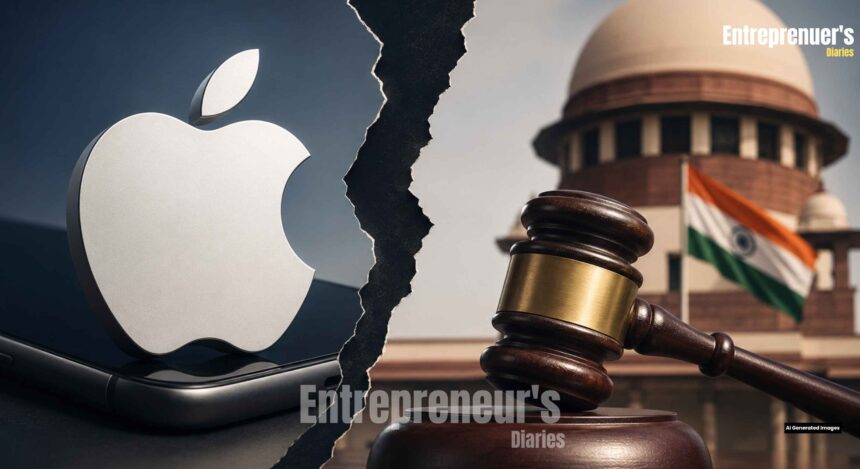
New Delhi, India, June 29, 2026: The Apple CCI antitrust case has reached a critical turning point as the global antitrust landscape facing Big Tech finds a new flashpoint in New Delhi. Apple has formally accused India’s competition watchdog of abandoning independent investigative rigor. Instead, the iPhone maker claims the regulator simply replicated complaints filed by its corporate rivals. This explosive allegation marks the most severe escalation in a four-and-a-half-year legal battle. It also sets the stage for a high stakes showdown over how India regulates dominant digital platforms. The outcome will ripple across the global tech economy.
Apple CCI Antitrust Case: The Sharpest Escalation Yet
According to regulatory papers reviewed by Reuters, Apple leveled these serious accusations in a formal submission filed on June 25, 2026. The company did not mince words.
Apple explicitly asked the Competition Commission of India (CCI) to completely quash the findings against it. The regulator had previously concluded that Apple abused its dominant market position.
This abuse was allegedly orchestrated through its proprietary App Store and mandatory in-app payment system. However, Apple is now aggressively pivoting its legal strategy.
The filing, reported for the first time by Reuters, serves as the clearest indication yet of Apple’s defense strategy. The company intends to fight the case on procedural grounds just as fiercely as it fights the underlying competition-law merits.
Deconstructing the “Copy-Paste” Allegation
At the heart of Apple’s June 25 submission is a detailed methodological critique. Apple constructed extensive comparison tables to prove its point.
These tables reportedly demonstrate a near-identical match between the CCI’s investigation findings and the private complaints of Apple’s competitors. The CCI’s investigation arm, known as the Director General (DG), is the target of this critique.
Apple alleges the DG failed to conduct an original, independent analysis of the mobile app ecosystem. Instead, the company claims investigators lifted submissions from opponents almost word for word.
The opponents named in Apple’s filing include some of the biggest names in the global and Indian digital economy. Tinder-owner Match Group is prominently mentioned.
Walmart-backed digital payments application PhonePe is also listed. Additionally, Indian digital payments rival Paytm is cited as a source whose claims were allegedly duplicated.
Apple argued that the DG made no genuine attempt to independently verify these claims. According to the submission’s wording as relayed by Reuters, the regulator repeated them without critical assessment.
Match Group, Paytm, and PhonePe did not respond to Reuters’ requests for comment regarding these specific allegations. Their silence leaves Apple’s procedural critique unchallenged in the public record for now.
Inside the CCI’s 2024 Findings Against Apple
To understand the gravity of Apple’s procedural attack, one must look back at the confidential 2024 report. It was this document that triggered the current phase of the standoff.
According to Reuters, CCI investigators concluded in this 2024 report that Apple engaged in abusive conduct. This abuse was specifically tied to its iOS app platform.
The core of the regulator’s finding rested on Apple’s payment mandates. The CCI determined Apple wrongly forced developers to use its proprietary payment system for all in-app purchases.
However, this 2024 finding did not materialize out of thin air. The dispute traces its origins back to a case initiated on December 31, 2021.
On that date, the CCI ordered a formal investigation. This order followed a complaint filed by a non-profit group named Together We Fight Society.
Legal filings summarized by law firm AZB & Partners detail the original complaint’s core grievances. The non-profit alleged Apple forced developers into highly restrictive distribution agreements.
Developers were allegedly required to distribute apps exclusively through the App Store. Furthermore, they were forced to use Apple’s in-app payment system.
The financial friction caused by this mandate was the primary complaint. Apple’s system carries commission rates of up to 30%.
This rate is astronomically higher than the standard processing fees typical of alternative payment systems. Alternative platforms generally charge between 2% and 5%.
The CCI’s characterization of the App Store has been notably harsh. According to earlier proceedings cited by trade outlet MediaNama, the regulator views the App Store as a trading partner.
Crucially, the CCI views it as a partner that developers in India cannot realistically avoid. Apple has consistently and strongly disputed this characterization of its business model.
The Legal Breadth of the Original Order
The CCI’s original 2021 order directing the investigation was sweeping in its scope. According to the AZB & Partners summary, the regulator found prima facie violations.
These violations spanned five separate sub-clauses of Section 4(2) of India’s Competition Act. This legal breadth is a critical factor in the ongoing delays.
Each sub-clause effectively demands its own distinct evidentiary record. The violations cover excessive pricing, which relates directly to the 30% commission.
They also cover the denial of market access, pertaining to the exclusive distribution mandate. Finally, they cover tying arrangements.
The tying arrangement claim asserts that Apple illegally bundled the App Store distribution with its in-app payment system. Apple now argues the DG outsourced the burden of building these complex evidentiary records to rival submissions.
Apple’s Central Defense: The Market Share Argument
When fighting allegations of dominant market abuse, the most logical defense is to prove a lack of dominance. This is exactly the path Apple has chosen.
Apple’s central defense to the CCI rests entirely on the metric of scale. The company explicitly told the CCI that it is a minuscule competitor in India.
According to Reuters, Apple claimed to hold less than a 6% share of the country’s total smartphone market. Apple argued the 2024 findings were entirely detached from this reality.
The company contends the regulator built its case on rival claims rather than objective market data. However, this figure sits in direct tension with independent market research.
Counterpoint Research data, cited by TechCrunch, tells a slightly different story. Their tracking found Apple’s India shipment market share reached a record 9% in 2025.
This represented a notable increase from 7% in 2024. This growth occurred on the back of the iPhone’s strongest year ever in the Indian market.
Apple did not respond to TechCrunch’s request for comment regarding this specific market data at the time. The discrepancy between Apple’s claimed sub-6% share and Counterpoint’s 9% shipment share creates a fascinating legal tension.
It forces the CCI to decide which metric accurately reflects Apple’s competitive power in the region.
The Disputed Graphic and Cross-Border Complications
Beyond the “copy-paste” allegation regarding rival submissions, Apple identified another procedural flaw. This one involves international regulatory overlap.
Apple accused CCI investigators of directly reusing a specific graphic. This graphic illustrated global consumer spending on mobile apps and games.
According to Reuters and Business Standard, this exact graphic originally appeared in a March 2024 European Union ruling against Apple. Apple argued this reuse was inappropriate given India’s vastly different market conditions.
A detailed Reuters review of the footnotes in both documents uncovered the root of the overlap. Both the EU order and the Indian DG’s report cited the exact same source.
That source was the data analytics platform Statista. While citing the same third-party data is not inherently illegal, Apple’s argument hinges on context.
Apple is implying the CCI adopted the EU’s analytical framework and conclusions alongside its data. This speaks to a broader anxiety within Big Tech regarding regulatory coordination.
Apple also raised concerns about the potential fallout of forced changes. According to Business Standard, Apple argued that altering its App Store rules would disrupt its integrated hardware-software model.
The company warned that imposed remedies would create deep regulatory uncertainty. This uncertainty, Apple claims, could deter future foreign investment in India’s rapidly growing digital economy.
The CCI and the head of its investigations division did not respond to Reuters’ queries regarding these specific claims. Apple also declined to comment to Reuters on the record for the story.
A Familiar Playbook: The Google Precedent of 2023
Apple is not the first American tech giant to employ this specific defense strategy in India. The precedent, however, is not encouraging for the iPhone maker.
In January 2023, Alphabet’s Google presented a nearly identical argument to an Indian appellate tribunal. According to CNBC, Google told the tribunal that CCI investigators had copied parts of a 2018 European Commission ruling.
Google claimed this copied text was inserted directly into the CCI’s order regarding Android mobile operating systems. The CCI’s response to Google was blunt and unambiguous.
“We have not cut, copy and pasted,” the regulator stated at the time, as reported by CNBC. The CCI completely rejected the premise of Google’s procedural attack.
Google had also attempted a macro-economic warning, much like Apple is doing now. According to Reuters, Google warned the Indian Supreme Court that the CCI’s Android order risked stalling the growth of India’s mobile ecosystem.
Despite this warning, Google ultimately lost its legal bid. The company was forced to make significant changes to how it promotes and licenses Android in India.
The financial penalties in the Google cases were substantial. According to the CCI’s own press release on cci.gov.in, the original Android order carried a penalty of ₹1,337.76 crore.
This figure translated to roughly $161 million at the time of the ruling. The legal battle did not end there.
The National Company Law Appellate Tribunal (NCLAT) upheld that fine in full in March 2023. However, the tribunal did show some leniency.
According to reporting from TechCrunch and legal outlet SCC Online, the NCLAT set aside four of the ten behavioral directives imposed on Google.
Google fared somewhat better in a separate but related case. In 2022, the CCI issued another penalty regarding Google’s Play Store billing policies.
According to Outlook Business, the original penalty in this matter was ₹936.44 crore. Upon appeal, this penalty was cut by 75%.
Google ultimately paid ₹216.69 crore to settle the Play Store billing dispute. Taken together, these Google cases establish a clear pattern.
Indian tribunals have shown a willingness to trim penalty amounts or remove specific behavioral directives. However, they have firmly rejected the broader claim that CCI investigators improperly copied foreign regulators’ work.
The Two-Year Standoff Over Financial Disclosures
While Apple attacks the CCI’s methodology, the CCI has leveled its own accusations of procedural bad faith against Apple.
The regulator has publicly accused Apple of actively stalling the case for more than two years. According to Reuters, this stall tactic centered on Apple’s failure to respond to the 2024 investigation findings.
A specific CCI order dated April 8, 2026, and cited by Inc42, laid out these frustrations. The regulator noted that Apple had not shared its financial details since October 2024.
Furthermore, Apple had completely failed to submit a formal response to the DG’s findings during that eighteen-month window. Apple, however, was not idle during this period.
Instead of engaging with the DG, Apple pursued a parallel legal track. In January 2026, Apple approached the Delhi High Court.
According to Inc42, Apple sought to challenge the constitutional validity of India’s antitrust penalty framework. The company also attempted to legally block the CCI from accessing its global financial records.
India’s penalty law is notoriously strict. As noted by Reuters, it allows fines of up to 10% of a company’s average turnover over the preceding three financial years.
The CCI had not specified which of Apple’s complex revenue streams would be used for this calculation. This legal ambiguity was the basis of Apple’s High Court challenge.
Apple has since at least partly relented on its disclosure defiance. According to Business Standard reporting in late April 2026, Apple agreed to submit localized data.
This data was tied specifically to its India business operations, ending months of intense delay. Reuters’ June 29 report confirmed the contents of this submission.
Apple’s filing now includes turnover figures for its India operations. These figures cover fiscal years 2022 through 2024.
This is precisely the type of localized financial data the CCI typically uses as the baseline for penalty calculations. Apple also raised a grievance regarding procedural fairness.
According to Business Standard, Apple argued it was never given an opportunity to record oral statements during the probe. The company explicitly contrasted its treatment with Google’s.
Apple noted that Google was granted multiple opportunities to verbally defend its business model during the Android investigation.
What Comes Next: Hearings, Penalties, and Timeline
The legal timeline is now accelerating rapidly. The CCI has scheduled a critical closed-door hearing.
According to Reuters, this hearing will take place on July 21, 2026. All parties involved in the case have been summoned to attend.
Whether Apple will receive a separate, dedicated oral hearing before the CCI’s members remains an open question. Gautam Shahi, an antitrust lawyer at Dua Associates, provided context to Reuters.
Shahi noted that the CCI’s investigation team is under no legal obligation to grant an oral hearing. This is especially true if the investigative team believes it already holds conclusive evidence.
The financial exposure hanging over Apple is immense. Earlier coverage from Business Standard in April 2026 pegged Apple’s theoretical maximum exposure at roughly $38 billion.
This astronomical figure assumes penalties are calculated against Apple’s broadest global turnover figures. However, Reuters’ more recent reporting introduces necessary nuance.
The CCI has not indicated which specific Apple revenues will actually be used for the calculation. Any eventual fine is highly likely to be far smaller than the theoretical maximum.
Yet, even a penalty running into the hundreds of millions of dollars would represent a major regulatory blow. Apple is actively preparing for this phase.
According to Reuters, Apple has asked the CCI to weigh specific mitigating factors if penalties are ultimately imposed. The company highlighted its completely clean compliance record in India.
Apple also leveraged its immense economic contribution to the country. The company noted it has exported iPhones worth $51 billion from India over the past five years.
Why India Matters More Than Ever to Apple’s Supply Chain
The timing of Apple’s aggressive legal escalation is not occurring in a vacuum. It coincides perfectly with India’s rapidly growing importance to Apple’s global manufacturing footprint.
The country is transitioning from a secondary market to a primary manufacturing hub. According to Counterpoint Research data cited by Reuters and Free Malaysia Today, India is on track to assemble 26% of the world’s iPhones in 2026.
This represents a staggering increase from just 6% four years earlier. Other industry trackers paint an even more aggressive picture of this growth.
Bloomberg reporting, cited by TechWire Asia, found Apple assembled roughly 55 million iPhones in India in 2025. This figure represents a 53% jump from the 36 million units assembled in 2024.
This production surge pushed India’s share of Apple’s total global output to approximately 25% in 2025 alone. The financial valuation of this manufacturing shift is massive.
Trade body IBEF reported that India assembled iPhones worth roughly $22 billion in the twelve months leading up to March 2025. This marked a nearly 60% increase year-on-year.
Of that $22 billion total, approximately $17.4 billion worth of iPhones were exported from India to global markets. Contract manufacturers are the engine driving this expansion.
Foxconn and Tata Electronics are central to Apple’s Indian strategy. According to IBEF’s analysis, Foxconn held roughly 65% of India’s iPhone production in 2024.
Tata Electronics accounted for about 35% of the production share in 2025. Tata is actively expanding its manufacturing capacity across the states of Tamil Nadu and Karnataka.
The geopolitical implications of this shift cannot be overstated. Apple is reportedly aiming to shift the bulk of iPhones bound for the U.S. market to Indian production.
This goal is targeted for completion by the end of 2026. This manufacturing transition adds immense geopolitical weight to Apple’s legal posture in New Delhi.
Apple is fighting India’s competition regulator at the exact moment it is asking India to host a quarter of its global manufacturing output.
This interconnected dynamic ensures that a purely adversarial legal strategy carries significant commercial risk for Apple.
The Bigger Picture: Global Antitrust Pressure on Apple
India is merely one front in a much broader, coordinated global regulatory campaign against Apple’s App Store model.
Regulators across three continents are simultaneously challenging how Apple operates its digital marketplace. In March 2024, the European Commission delivered a massive blow.
According to a statement from the Commission, it fined Apple roughly €1.8 billion, or about $2 billion. The fine was issued for blocking music-streaming rivals from informing users about cheaper subscription options outside the App Store.
European Commission competition chief Margrethe Vestager delivered a stark condemnation at the time. She stated publicly that Apple abused its dominant position over a decade-long period.
That exact same month, the United States launched its own assault. The U.S. Department of Justice, joined by 16 state attorneys general, sued Apple in New Jersey federal court.
According to the DOJ’s own press release, the lawsuit alleged Apple illegally maintains a smartphone monopoly. The complaint targeted restrictions on third-party developers, messaging interoperability, and smartwatch compatibility.
Apple moved to dismiss this sweeping federal case. However, according to legal analysis from law firm Mintz, a federal judge denied Apple’s motion to dismiss in June 2025.
This denial allowed the core monopolization claims to proceed toward trial. Apple has disputed both the EU and US cases on strikingly similar grounds.
The company argues its integrated ecosystem fundamentally benefits consumers through enhanced privacy and security. Furthermore, Apple contends regulators are defining relevant markets too narrowly.
By narrowing the market definition, Apple argues regulators are artificially manufacturing a dominance finding that would not hold up under broader scrutiny.
The CCI matter adds a third major jurisdiction to this list. New Delhi, alongside Brussels and Washington, is now actively contesting Apple’s app and payment ecosystem.
For context on the scale of these battles, the DOJ’s own complaint noted Apple’s immense financial resources. Apple generated $383 billion in net revenue and $97 billion in net income in fiscal 2023 alone.
This financial scale underscores a difficult reality for regulators. Even a multi-billion-dollar penalty in a single jurisdiction is unlikely to fundamentally alter Apple’s behavior.
Because of this, regulators are increasingly favoring structural remedies over simple financial fines. They want to force interoperability and mandate alternative payment options.
South Korea took the earliest and most aggressive step down this path. According to MediaNama’s review of the global regulatory landscape, South Korea became the first country to legally require Apple and Google to open their app stores to alternative payment systems in 2021.
Seoul’s competition authority opened a fresh investigation into both companies in October 2023 over continued related concerns.
The Inevitable Intersection of Law and Logistics
For investors, tech operators, and policy architects tracking Big Tech’s regulatory exposure, the Apple-CCI fight is about much more than a dramatic “copy-pasting” headline.
It is a structural stress test repeating across global jurisdictions. The fundamental question is whether walled-garden, commission-based App Store models can survive sustained, coordinated scrutiny from regulators who are visibly comparing notes across borders.
The Statista-graphic overlap that Apple aggressively flagged is a small but highly telling data point. It suggests that competition authorities, faced with globally standardized tech business models, are increasingly drawing on the exact same limited pool of public market data.
They are also likely drawing on each other’s prior legal findings to build their distinct cases. For under-resourced regulatory bodies, this is a highly defensible research shortcut.
However, it is also a genuine, exploitable procedural vulnerability. Sophisticated legal respondents like Apple, and Google before it, will continue to weaponize these overlaps in appellate courts to muddy the waters and delay enforcement.
The more fascinating tension for market analysts is the market-share paradox. Apple’s self-described status as a minuscule competitor—claiming under 6% share—sits awkwardly next to Counterpoint Research’s independently tracked 9% shipment share and a dominant 23% value share in India.
These figures prove Apple has been quietly, relentlessly compounding its share in the world’s second-largest smartphone market. It is doing this simultaneously while fighting to be legally characterized as a fringe participant unworthy of dominant-firm regulation.
Whichever legal framing the CCI ultimately accepts will directly shape how aggressively other regulators in emerging markets feel emboldened to pursue similar App Store cases. If the CCI dismisses the low-market-share defense, it creates a blueprint for establishing dominance based on ecosystem value rather than sheer unit volume.
Ultimately, the procedural legal threads and the commercial supply-chain realities are now completely inseparable. Apple is leaning heavily on India to localize a quarter or more of its global iPhone production.
It is doing this right as it fights India’s primary competition regulator over how it monetizes that exact same ecosystem domestically. A purely litigated, punitive outcome serves almost no one perfectly.
A negotiated settlement, rather than a fully litigated penalty, may ultimately serve both sides better. The CCI would secure tangible compliance changes and behavioral remedies without enduring years of appellate delays.
Apple, in turn, would protect its rapidly expanding, multi-billion-dollar manufacturing relationship with New Delhi from the collateral damage of a protracted legal war. In the modern era of tech regulation, geopolitical logistics eventually dictate legal strategy.
Frequently Asked Questions
What did Apple accuse India’s CCI of doing in its recent legal filing?
Apple accused the Competition Commission of India’s investigation arm, the Director General, of “copy-pasting” claims directly from competitors like Match Group, PhonePe, and Paytm. In a June 25, 2026 submission reviewed by Reuters, Apple claimed the regulator failed to conduct an independent analysis and instead replicated rival submissions almost word for word.
What is the core of the CCI’s antitrust case against Apple in India?
The CCI is examining whether Apple abuses its dominant market position through its App Store rules. Specifically, the regulator is investigating Apple’s mandate that developers use its proprietary in-app payment system, which charges commissions of up to 30%, compared to the standard 2-5% processing fees of alternative payment systems.
How much could Apple be fined in the CCI antitrust case?
Under India’s Competition Act, the CCI can impose fines of up to 10% of a company’s average turnover over the preceding three financial years. While a theoretical maximum exposure of $38 billion has been floated if global revenues are used, the CCI has not specified which revenue streams will be used, meaning the actual fine will likely be significantly lower, though still potentially in the hundreds of millions of dollars.
What was the outcome when Google used a similar “copy-paste” defense against the CCI?
Google used a nearly identical defense in January 2023, accusing the CCI of copying a 2018 EU ruling into its Android antitrust order. The CCI bluntly denied the claim, stating, “We have not cut, copy and pasted.” Google ultimately lost the challenge, and the appellate tribunal upheld the ₹1,337.76 crore fine, though it did remove four of the ten behavioral directives, offering a mixed precedent for Apple.
Why is the timing of this antitrust case critical for Apple’s global operations?
The legal battle coincides with India becoming a crucial manufacturing hub for Apple. According to Counterpoint Research and IBEF data, India is on track to assemble 26% of the world’s iPhones in 2026, with export values reaching $17.4 billion. Apple’s aggressive legal posture risks clashing with the Indian government at the exact moment Apple is relying on the country to diversify its global supply chain away from China.
The legal battle coincides with India becoming a crucial manufacturing hub for Apple. According to Counterpoint Research and IBEF data, India is on track to assemble 26% of the world’s iPhones in 2026, with export values reaching $17.4 billion. Apple’s aggressive legal posture risks clashing with the Indian government at the exact moment Apple is relying on the country to diversify its global supply chain away from China.
Connect With Us On Social Media [ Facebook | Instagram | Twitter | LinkedIn ] To Get Real-Time Updates On The Market. Entrepreneurs’ Diaries Is Now Available On Telegram. Join Our Telegram Channel To Get Instant Updates.

Isabella is a global business journalist and former McKinsey analyst from Brazil. She brings sharp insights on economic shifts, policies, and founder journeys from around the world.

Tokyo-based CFA translating global markets into clear insights for modern entrepreneurs.